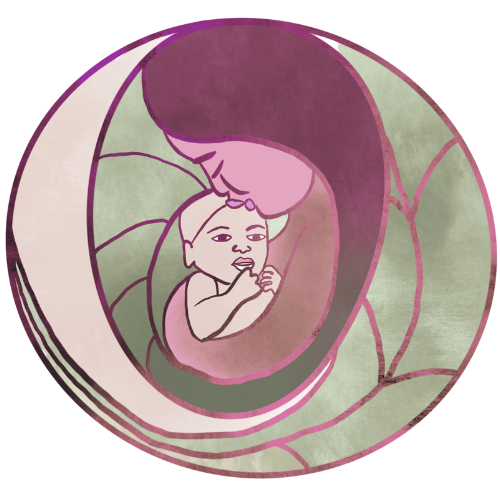
The Generative Work: Making Things While You're Growing a Human
Being Creative
Pregnancy is the most creative state your body will ever be in. That's not metaphorical—it's literally true. Your entire being is engaged in the act of creation: building organs, generating blood volume, orchestrating the most complex biological process that exists. You're not just growing a human. You're in a state of active generative power.
Here's what nobody talks about: that same creative energy you're using to make a baby can flow into your hands and through your art. Not because you need to "prepare" or "prepare your baby's brain" or do one more thing perfectly. But because tapping into that generative current is one of the most grounding, calming, presence-building things you can do while you're pregnant.
This isn't about nursery-room crafts from the 90s. This isn't scrapbooking or complicated projects that require special supplies. This is about the kind of making that asks very little of you while giving back calm, focus, and a sense of agency when so much of pregnancy feels like things happening to you rather than through you.
Why Making Matters Right Now
Your nervous system during pregnancy is doing a lot. It's preparing for labor. It's adjusting to physical changes. It's processing the enormousness of what's coming. Crafting—slow, purposeful, sensory-based making—is one of the most direct ways to regulate your nervous system while simultaneously staying present.
When you make something, especially something simple and repetitive, your nervous system downshifts. Your brain stops spinning through anxieties and settles into task-focused awareness. This is what neuroscientists call "flow state," and it's genuinely therapeutic. Your baby benefits too—not because they're absorbing your creativity, but because your calm nervous system means their developing nervous system gets to incubate in a regulated environment. Research shows that fetal heart rate patterns become more stable when the mother is relaxed and engaged in peaceful activity.
There's also something about the physicality of making that matters during pregnancy. In East Slavic tradition, pregnant women made dolls during pregnancy in which they put all their worries, gloomy thoughts, or unwanted energies of others—then threw the doll away after birth. That practice wasn't just spiritual theater. It was a way of externally processing internal experience. Making something with your hands is a form of emotional alchemy. What lives in your mind becomes something concrete that you can touch and examine and ultimately release.
And then there's the chakra piece, if that's a framework that resonates with you. During pregnancy, your sacral chakra—the seat of creativity, sexuality, and generative power—is especially activated. Whether you believe in chakras or not, pregnancy is objectively a time when your creative capacity is heightened. Your body is literally creating. Engaging in artistic practice while you're in this state isn't separate from the work your body is doing—it's an extension of it.
The Soundtrack for Your Making
You need music that doesn't demand anything from you but creates a held, creative space. Not music that excites you. Not music that makes you want to move fast. Music that makes you want to slow down, focus, and let your hands do their work.
Ella Fitzgerald is essential here. Try "Dream a Little Dream of Me" or "Summertime"—the haunting signature melody from Gershwin's opera, a swooning, jazzy shade of the lullaby. The Cole Porter and Gershwin Songbooks are perfect for this—sophisticated enough to keep your brain engaged, relaxing enough to not create pressure.
Rising Appalachia brings that grounded Appalachian folk energy. Try their albums "Leylines" or "Hair Downstream"—their music has a meditative, circular quality that's perfect for repetitive crafting.
Folk artists like Kaia Kater, The Stray Birds, and Elephant Revival (all working in similar traditions) offer music that's folk-rooted without being twee. Kaia Kater's "Midnight Skies" album is particularly grounding.
For something with a bit more embodied rhythm—if you want music that honors the movement of your body even while you're sitting still—try belly dance music artists like Amira Medunjanin or Natacha Atlas. Their music has a sensual, circular quality that honors your pregnant body without making demands on it.
The common thread: music that's acoustic, unhurried, and doesn't spike your energy. Music that lets you disappear into your hands and your making.
Seven Crafts You Can Actually Do (And Actually Finish)
1. Zen Tangles
You don't need to be an artist. You need a pen, paper, and nothing else. Zentangle is literally just making repetitive patterns inside outlined shapes. Your brain isn't solving problems—it's following a meditation-like progression. Look up basic patterns online (there are thousands), then just let your hand follow. There's nothing to finish or perfect. The tangle is done when you feel done.
Why this works: Deeply meditative. Impossible to do wrong. Portable. Takes as little or as much time as you have.
2. Soul Collage
Cut images from old magazines (free if you don't buy new ones). Glue them onto cardstock. That's it. You're not creating a coherent image. You're arranging images that speak to something in you—images of the person you're becoming, the baby coming, what you need, what you're releasing. It's collage as emotional processing.
Why this works: You get to externalize your internal state. Nothing is wrong because you get to define what it means. You're literally putting your feelings into physical form.
3. Fabric Garlands
Collect fabric scraps, old t-shirts, worn out sheets. Cut them into strips. String them on twine or yarn using a needle. Hang them on your wall, in a window, across your room. Instant visual magic made from things you already have. Easy to take down and remake if you want.
Why this works: Uses what you already have. Slow repetitive action. Something beautiful to look at at the end that you made. Free.
4. Pressed Flowers and Leaves
Walk outside. Pick a few flowers, leaves, or interesting plants. Place them between two sheets of glass (picture frames work perfectly) or between pages of a heavy book to press them. After a week or two, arrange them in the glass frames and hang on your wall. Optional: press them faster by putting them between coffee filters in the microwave for a few seconds.
Why this works: Connects you to nature. Meditative. Requires almost no materials. Results in something permanent and beautiful that marks this time of your life.
5. Clove-Studded Dried Fruit
Take an orange, lemon, or apple. Stud the entire surface with whole cloves, pushing them in with your fingers or a nail. The process itself is meditative—there's a rhythm to it. The result: something that smells incredible, looks beautiful, and turns your home into a place of calm. You can hang them with twine or ribbon, or just place them in bowls around your space. They last for months.
Why this works: Slow, repetitive, meditative. The sensory payoff is immediate—your space smells amazing. Free if you have fruit and cloves at home, very cheap if you don't. Creates lasting beauty.
6. Upcycled Cardboard Projects
Save sturdy cardboard boxes from deliveries. Cut them into geometric strips. Paint them (use leftover paint, or natural dyes like beet juice or turmeric water). Fold or roll them into narrow sculptural elements, then hot-glue them to your wall as three-dimensional shelving units or art installations. Or make simple geometric wreaths by interlocking painted cardboard pieces. Or decoupage your painted cardboard with images you tear from magazines, then seal with clear polycrylic.
Why this works: Uses recycled materials. Involves multiple meditative steps if you want them (painting, cutting, assembling). Turns something destined for the recycling bin into something beautiful. Costs essentially nothing.
7. Herbal Infused Room Spray
Mix water with a few drops of essential oils you have on hand. Add a sprig of something from your yard—a branch of lavender, rosemary, mint, or anything that smells good to you. Add a tiny bit of rubbing alcohol if you have it (helps the oils mix, but isn't necessary). Pour into a spray bottle. Tie a ribbon around the neck. Shake before each use.
To keep it fresh: use distilled or boiled water that's cooled. Store it in a cool place. Add a tiny pinch of vitamin E or a few drops of vegetable glycerin if you want it to last longer (helps prevent the growth of bacteria). Use it on your pillows, in the air, on your body. Every time you spray, the scent reminds you of the act of making something intentional for yourself.
Why this works: Involves selecting scents that feel right for you. Simple enough that you can't fail. Creates something you'll use daily and that reminds you of your creativity every time you spray it. The act of creating and using something you made is grounding.
The Deeper Thing: Creation as Your Birthright
What's happening inside your body right now—the generative power, the building, the orchestration of new life—is not a one-time event. It's an expression of the same creative force that flows through art, music, writing, movement, and every human act of making something from nothing.
Pregnancy is the moment when this becomes viscerally obvious. Your body is literally creating. And when you move that energy into your hands—making marks on paper, arranging colors, building something physical—you're not taking time away from the work your body is doing. You're amplifying it. You're saying: "I am a being who creates. Creating is my fundamental nature, not just biologically but artistically, spiritually, energetically."
That knowing—that you are generative, creative, capable of bringing things into being—is going to matter during labor. It's going to matter during early parenthood. It's going to matter for the rest of your life. You're building the neural pathways now.
A Permission Slip
You don't have to finish anything. You don't have to make it beautiful. You don't have to use your crafting as preparation for your baby or as a way to be a better parent. You're making things for you. You're engaging in a practice that regulates your nervous system and honors the creative power that's already moving through you.
You can make something today and throw it away tomorrow. You can start ten projects and finish none of them. You can repeat the same craft over and over. None of it is wrong. The making is the point, not the product.
If you want support during this time—not just for the physical changes but for the creative and spiritual transformation of pregnancy—reach out to Nets right here at Fruit of the Womb. Midwifery care that honors your whole self means honoring your creativity, your spirituality, your need to slow down and make space for what's emerging. Nets works with pregnant people who want to engage with this time as a sacred generative period, not just a medical event.
Schedule a free consultation at [Fruit of the Womb contact page] or reach out directly at 240-997-5319 or netsitsah@hotmail.com. Serving Baltimore City, Baltimore County, Carroll County, and Howard County, Maryland; York County, Pennsylvania.
Frequently Asked Questions
Do I need to buy special craft supplies?
No. Every craft in this article uses things you likely already have: paper, pen, cardboard, magazines, old fabric, fruit, plants from your yard, essential oils, water. If you don't have something, it's genuinely cheap—cloves, twine, glass frames. The point is that making shouldn't create financial stress. If you find yourself spending money on supplies, you're overthinking it. The constraints are actually helpful. They force you to be creative within real limitations.
What if I'm not "artistic"?
This isn't about art. It's about making. Some of the most meditative crafts require zero artistic ability—you're literally just moving your hands in a repetitive pattern or assembling things that speak to you. Zentangle doesn't need skill. Collage doesn't need skill. Studding fruit with cloves doesn't need skill. You're not trying to create something museum-worthy. You're trying to engage in an act of making while your nervous system downshifts.
How much time should I spend on this?
Whatever time you have. Five minutes of zentangling counts. Fifteen minutes of cutting fabric strips counts. An hour of working on a cardboard project counts. The time itself isn't the point—the consistency of showing up and making something is. Even once a week, for whatever amount of time you can find, is enough to create a meaningful practice.
What if I start something and hate it?
Stop and do something else. Not every craft is going to resonate with you, and that's fine. The practice is about finding what makes your nervous system settle and your hands want to engage. If collage feels forced, don't do collage. If zentangle feels like meditation and you love it, do more zentangle. This is permission-based, not prescription-based.
Can my partner or family members do these crafts with me?
Sure, if that feels good to you. Or not—you might need the solitude and the space to make without commentary or help. Some pregnant people want company during this time. Some want to be alone with their hands and their music. Both are valid. You get to decide what you need.
What if I make something and then don't know what to do with it?
Display it, keep it, give it away, throw it away. Your pressed flowers might live on your wall for years or in a box in your closet. Your fabric garland might decorate your pregnant belly or be something your kid wears in a play. Your clove-studded oranges might smell up your whole house or end up in the compost. The making is the point. What happens to the object afterward is secondary.